

Blog: Art-Kubed
AI, Moral Responsibility, and the Work of Keeping People Safe
Something worth pausing on is happening across the world's spiritual and philosophical traditions right now: they are converging — not on doctrine, but on a shared sense of urgency about artificial intelligence.
Something worth pausing on is happening across the world's spiritual and philosophical traditions right now: they are converging — not on doctrine, but on a shared sense of urgency about artificial intelligence.
This week, Pope Leo XIV released Magnifica Humanitas, a 42,300-word encyclical warning of AI-guided weapons, the concentration of AI power among those who disregard human welfare, and the erosion of dignity and privacy — particularly for young people. He frames calls for more thoughtful AI governance not as opposition to progress, but as "an exercise of responsible care for the human family." As a voice for more than a billion people, that framing deserves to be heard.
But it is far from a solitary one. The Dalai Lama's 2025 Mind & Life dialogue — convened specifically around "Mind, Artificial Intelligence, and Ethics" — examined AI's potential to alleviate suffering alongside its very real risks to health, education, work, and democratic life. The institute's chairman noted plainly: "We will need to draw on the deepest and most diverse resources of human knowledge to prevent the terms of the discussion and debate being taken over by loud voices. The future of humanity is at stake." A multi-faith panel convened in the UK that same year drew together Christian, Islamic, and Jewish scholars to examine how AI is entering spaces once reserved for human wisdom, cautioning against the "silent adoption" of AI without reflection or accountability. Islamic scholars have emphasized that AI must align with principles of equity and justice. Jewish ethical tradition grounds the question in tikkun olam — the obligation to repair rather than harm the world. Hindu and Buddhist frameworks ask whether a technology reduces suffering and preserves the right relationship, or undermines it.
We mention these voices not to claim them as our own or to speak on their behalf. We are a security company, and these are rich, complex traditions that deserve far more engagement than a blog post can offer. But the convergence is notable, and we think it points at something real: the question of how AI is governed is not only a technical question. It is a deeply human one.
If AI's Spread Is Inevitable, What Are We Obligated To Do?
There is a version of this conversation that ends in fatalism — AI is happening, the competitive incentives are too powerful, nothing will slow it down. And there is some truth to that. Gartner projects that by the end of 2026, roughly 40% of enterprise applications will integrate task-specific AI agents, up from less than 5% today.
But the moral leaders engaging this question are not, for the most part, calling for prohibition. They are asking something more demanding: given that this is happening, what are our obligations? That question has always accompanied major technological shifts — and how seriously it is taken tends to determine whether a technology ultimately serves human flourishing or undermines it.
We don't think Operant is the answer to that question. We think we're one small part of it. What we can do is make the AI that enterprises are already deploying more visible, more controllable, and less exploitable. That feels, to us, like a worthwhile and necessary contribution — however modest — to a much larger challenge.
What We Actually Do
The concerns raised across these traditions are not abstract — they map to specific, measurable failures in how AI systems are built and deployed today. Here is where Operant's tools speak directly to the moral requirements these leaders have articulated.
AI Gatekeeper — Addressing the Demand to Protect Human Dignity and Privacy
Among the most consistent concerns raised by Pope Leo, Buddhist ethics, and the Hindu principle of ahimsa (non-harm) is the risk of AI systems causing harm to individuals through data exposure and the erosion of privacy — particularly for people who have no idea it is happening to them. Most people interacting with AI-assisted systems in healthcare, banking, insurance, or customer service have no visibility into what happens to their data once it enters an AI pipeline. They are not consenting to their medical histories, financial records, or personal identifiers being processed, stored, or potentially exposed by AI tools their providers deployed without adequate safeguards. The harm is real; the invisibility of it makes it worse.
Pope Leo specifically named this erosion of privacy and dignity as a central concern. The Dalai Lama's framing is perhaps the most direct: the ethical test for any technology is whether it alleviates suffering or causes it. For the patient whose diagnosis notes flow through an unsecured AI summarization tool, or the banking customer whose account details pass through an LLM that logs and retains sensitive fields, the answer today is often the wrong one.
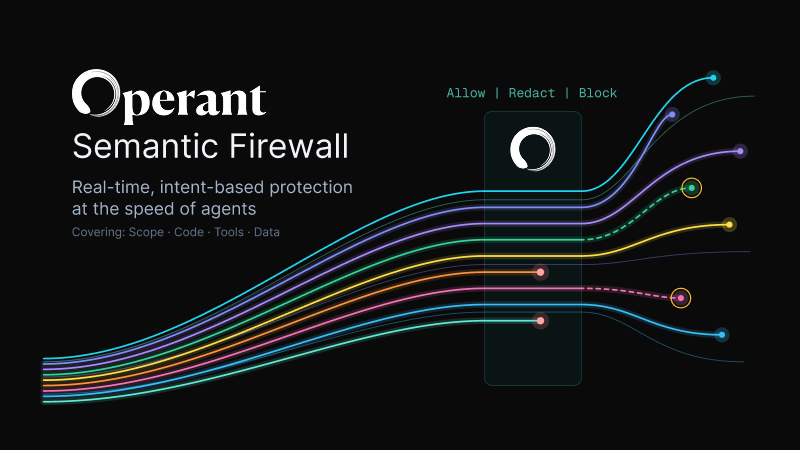
Operant's AI Gatekeeper operates inline — meaning it sits directly within the AI application layer, acting before data ever reaches a model in an unsafe form. It automatically detects and redacts PII, PHI, and PCI data in motion, blocks exfiltration attempts in real time, and enforces privacy policies without requiring the end user to do anything at all. That last part matters: the people most at risk are not the ones who can configure a privacy setting. They are the ones who simply went to a doctor or called their bank. AI Gatekeeper works to protect them at the infrastructure level, where protection actually has to live.
Agent Protector — Addressing the Demand for Human Oversight
Pope Leo XIV's encyclical is explicit that AI must remain subject to "ethical and political oversight" and must not be allowed to operate in ways that undermine "the identity and dignity of the human person." The Dalai Lama's 2025 dialogue raised parallel concerns about AI systems operating beyond meaningful human understanding or control — what his colleagues described as the risk of "loud voices" (including automated ones) drowning out human judgment.
Autonomous AI agents are the sharpest edge of this problem. They act, make decisions, and affect real people — often faster than any human can review. Operant's Agent Protector monitors agents continuously at runtime, detecting rogue behavior, prompt injection, agentic drift, and zero-day vulnerabilities before damage occurs. It doesn't make agents slower; it makes their behavior legible and stoppable — a direct contribution to the non-negotiable requirement that humans remain meaningfully in the loop.
MCP Gateway — Addressing the Demand for Transparency and Accountability
Pope Leo's encyclical, the Dalai Lama's ethics dialogues, and Hindu frameworks grounded in dharma all converge on a shared principle: that power — including the power conferred by technology — must be exercised transparently and with accountability. The MCP integration layer is precisely where that accountability breaks down in most enterprises today. Gartner has been direct: "MCP was originally designed for interoperability, where cybersecurity is optional." The result is that AI agents are connecting to tools, data sources, and external services through pathways that organizations frequently cannot see, audit, or control.
Operant's MCP Gateway provides real-time discovery, detection, and defense across every MCP server and tool in use — cataloging both sanctioned and shadow deployments, surfacing live traffic between AI clients and servers, and enforcing access controls across the full integration layer. It is, in effect, an accountability layer for the connective tissue of enterprise AI.
Endpoint Protector — Addressing the Demand for Stewardship Over What We Deploy
Hindu thought in particular frames the ethical use of technology through the lens of responsible stewardship — the idea that humans bear accountability not just for intended outcomes but for the full consequences of what they create and deploy. The multi-faith scholars who convened in 2025 gave this a practical name: "silent adoption" — the quiet, unconsidered handoff of human judgment to AI systems, without transparency about what those systems are actually doing.
In most enterprises today, employees across every function are using AI tools — many of them unsanctioned, nearly all of them unmonitored at the endpoint level — that touch personnel records, financial data, source code, and customer information. Organizations often genuinely do not know what AI their workforce is using or what data it is processing. Operant's Endpoint Protector addresses that specific gap: full discovery of AI tool usage across the enterprise, real-time agent loop tracing, and inline defenses for data exfiltration and prompt injection inside the encrypted channels that legacy security tools cannot inspect — giving organizations the visibility they need to begin exercising genuine stewardship over their AI deployments.
A Small Part of a Necessary Response
The world's moral traditions are asking hard questions about AI, and they deserve serious answers — from policymakers, from AI developers, from ethicists, and from the enterprises deploying these systems at scale. We're proud to play a small technical role in that broader project: helping organizations see what their AI is doing, control how it handles sensitive information, and defend against the people who would exploit it.
That doesn't solve the larger question. But we think it matters. And we're committed to doing it well.
Learn more about Operant's AI Defense Platform at operant.ai.
.avif)
.avif)